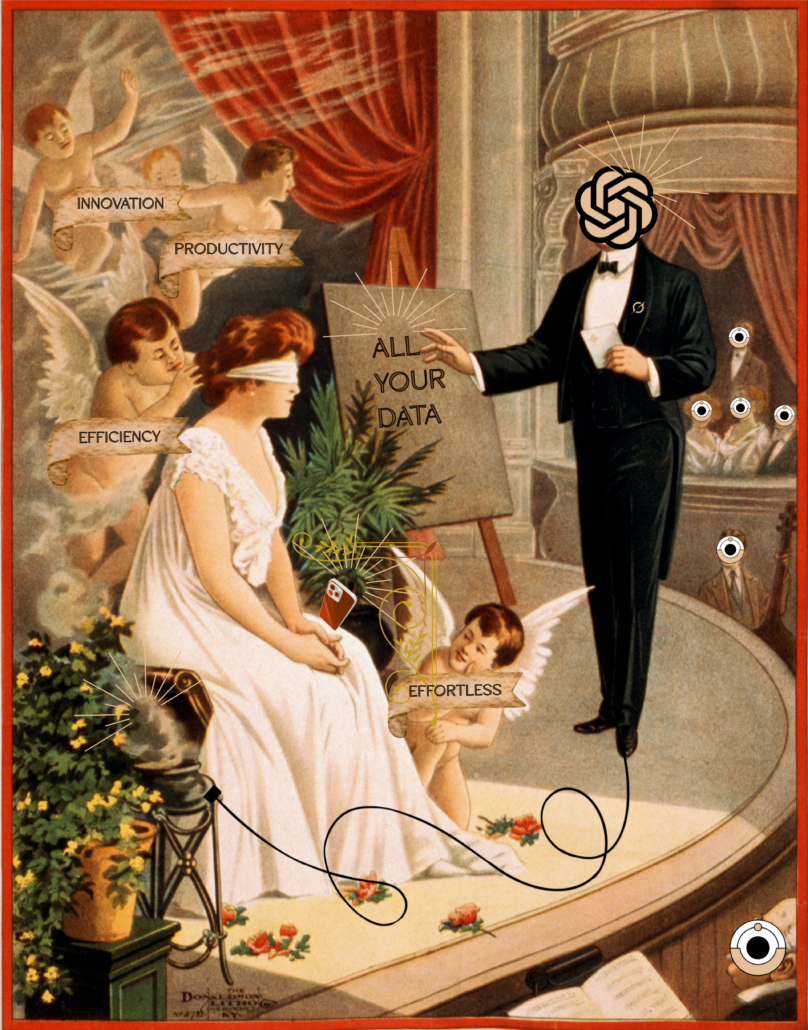
 Daniela Zampieri / https://betterimagesofai.org / https://creativecommons.org/licenses/by/4.0/
Learning Call (26 October): Can the EU Regulate the Attention Economy?
Date: Monday, 26 October
Time: 16:00-17:15 (CEST)
Moderator: Natali Helberger (IViR, University of Amsterdam)
Speakers: Marijn Sax (IViR, University of Amsterdam), Cecilia Isola (NOVA School of Law of Lisbon), Matteo Fabbri (Institute for Logic, Language and Computation / IViR, University of Amsterdam)
Registration: Register here
This Learning Call, part of an ongoing series on current issues surrounding the Digital Services Act (DSA), examines the EU’s evolving approach to regulating recommender systems and harmful design practices on online platforms.
The pervasiveness of short-form video feeds and increasingly sophisticated algorithmic personalisation have supercharged platforms’ business models built around maximising engagement and monetising our attention. These developments have also raised public concerns about privacy, addictive use, and the amplification of harmful content, particularly among children.
EU regulators are responding with a growing arsenal of legal instruments. The DSA already prohibits certain dark patterns and imposes obligations concerning recommender systems within its transparency and systemic risks framework. The newly proposed KIDS Act targets addictive features such as infinite scrolling and reward mechanisms, as well as the design of recommender systems, with the aim of protecting minors. Meanwhile, the forthcoming Digital Fairness Act (DFA) proposal promises broader consumer safeguards against harmful design practices.
Considering this regulatory context, speakers will examine the practical and conceptual challenges of regulating dark patterns, what platforms’ risk assessments reveal about their approach to mitigating addiction risks, and what recent enforcement proceedings and private litigation can tell us about the DSA’s practical application to recommender systems and interface design.
Ultimately, the session asks what interventions can meaningfully challenge the underlying incentives driving platforms to maximise engagement at the expense of users’ (and not only children’s) well-being. Is the EU’s current regulatory approach up to the task? And can it keep pace with the new (and dreadful) possibilities for manipulation and dependency introduced by generative AI?
Image attribution: Daniela Zampieri / https://betterimagesofai.org / https://creativecommons.org/licenses/by/4.0/
Speakers
Marijn Sax is an assistant professor at the Institute for Information Law (University of Amsterdam). He researches the ethics and regulation of online influence.
Cecilia Isola is a postdoctoral researcher in European Private Law at NOVA School of Law in Lisbon. Her work focuses on consumer law and digital regulation, particularly the legal implications of emerging online commercial practices, such as dark patterns and addictive design, and their effects on users’ autonomy and decision-making.
Matteo Fabbri is a postdoctoral researcher at the Institute for Logic, Language and Computation and a fellow at the Institute for Information Law (University of Amsterdam). He focuses on the impact of EU digital regulation on the design of recommender systems.
Natali Helberger (moderator) is Distinguished University Professor of Law and Digital Technology, with a special focus on AI at the University of Amsterdam, and affiliated with the Institute for Information Law (IViR). She is one of the founders and director of the AI, Media & Democracy Lab, and of the algosoc Gravitation program.
About the Learning Call Series
This series brings together researchers and practitioners to discuss current developments and emerging questions related to the Digital Services Act and its implementation. It is organised by the Alexander von Humboldt Institute for Internet and Society in collaboration with the Leibniz Institute for Media Research | Hans-Bredow-Institut (HBI), and the DSA Observatory, with support from the Network of Centres (NoC), and as part of the DSA Research Network, funded by Stiftung Mercator.
About the Network of Centers (NoC)
The NoC is a collaborative initiative among academic institutions with a focus on interdisciplinary research on the development, social impact, policy implications, and legal issues concerning the Internet. This collective aims to increase interoperability between participating centers in order to stimulate the creation of new cross-national, cross-disciplinary conversation, debate, teaching, learning, and engagement regarding the most pressing questions around new technologies, social change, and related policy and regulatory developments.
About the DSA Research Network
The DSA Research Network aims to establish a unique space for communication and collaboration on the implementation of the Digital Services Act, with a strong focus on making early recommendations on potential areas for reform. Following a network-based approach, the project sets out to add value to already existing initiatives that have been formed to accompany the process of implementation. By providing a platform for cross-sectoral dialogue between academics, practitioners, NGOs, and regulators, we facilitate the creation of actionable knowledge and foster a culture of collaboration.
Partners
The DSA Research Network is a collaboration between the Alexander von Humboldt Institute for Internet and Society, the Leibniz Institute for Media Research | Hans Bredow Institute, and the DSA Observatory, University of Amsterdam. It is funded by Stiftung Mercator.