State of Play of DSA Dispute Settlement: Meaningful Redress, Uneven Results
Niklas Eder, Agata Russo — User Rights
Agne Kaarlep, Laura Zurdo, Toshali Sengupta — Tremau
After almost two years of certified out-of-court dispute settlement (ODS) bodies operating under Article 21 of the Digital Services Act (DSA), the first transparency reports provide early evidence of how this new due process layer operates in practice. Drawing on 2025 data from multiple ODS bodies, this article assesses what value the system is already delivering, and where current constraints, including platform participation and information-sharing, limit its effectiveness. We discuss possible ways forward, including stronger incentives, technical infrastructure and feedback loops.
Introduction
Almost two years after Europe’s first online dispute settlement body began work, the experiment is yielding early signs of what due process in the digital age might look like. Nine such bodies have been certified across eight EU Member States and some of them have published transparency reports. These early transparency reports provide the first evidence of how Article 21’s promise translates into practice. What is the state of play? And what value does this system add to users and platforms?
Article 21 DSA — One year in
One of the most innovative provisions of the DSA, Article 21 establishes a framework under which organisations meeting standards of independence and expertise may be certified as ODS bodies to adjudicate content moderation disputes between EU users and online platforms, free of charge to users.
In broad terms, EU users can file a complaint with an ODS body if a platform restricts their content, or if a platform chooses not to act on content that the user had reported as violating platform rules or applicable law. Importantly, under DSA Article 17, platforms are required to inform users (following an enforcement action taken against their content or account) that they have the right to redress either via on-platform appeal mechanisms, ODS bodies, or judicial redress. While ODS bodies’ decisions are non-binding, platforms have an obligation to engage with them in good faith.
Beyond setting out general principles, the DSA left much of the practical design of the ODS system to its stakeholders, allowing the ODS bodies to define the EU languages in which they operate and the types of content or harms they review.
Five ODS bodies have published transparency reports thus far:
- User Rights
- Appeals Centre Europe (ACE)
- Central European Appeals Hub (CEAH)
- RTR-GmbH Streitbeilegungsstelle (in German)
- Online Platform Vitarendező Tanács (OPVT) (in Hungarian)
The release of these ODS transparency reports provides a timely opportunity to assess the system’s added value, identify its current challenges, and consider its future development. While the ODS mechanism affects a broad range of stakeholders, this piece focuses on its implications for users and online platforms.
Value and effectiveness for users
The ODS system, as conceived under Article 21 DSA, aims to provide a new, accessible, effective and affordable path for users to challenge content moderation decisions. It exists parallel to the court system, addressing a known gap in redress where court action may be impractical.
Over their respective reporting periods, these five ODS bodies reported tens of thousands of eligible disputes and decisions. Together, they handled complaints across more than a dozen platforms, spanning all 27 Member States. This scale of activity moves Article 21 DSA from legislative design to operational reality and provides a concrete basis for assessing how the mechanism performs in practice.
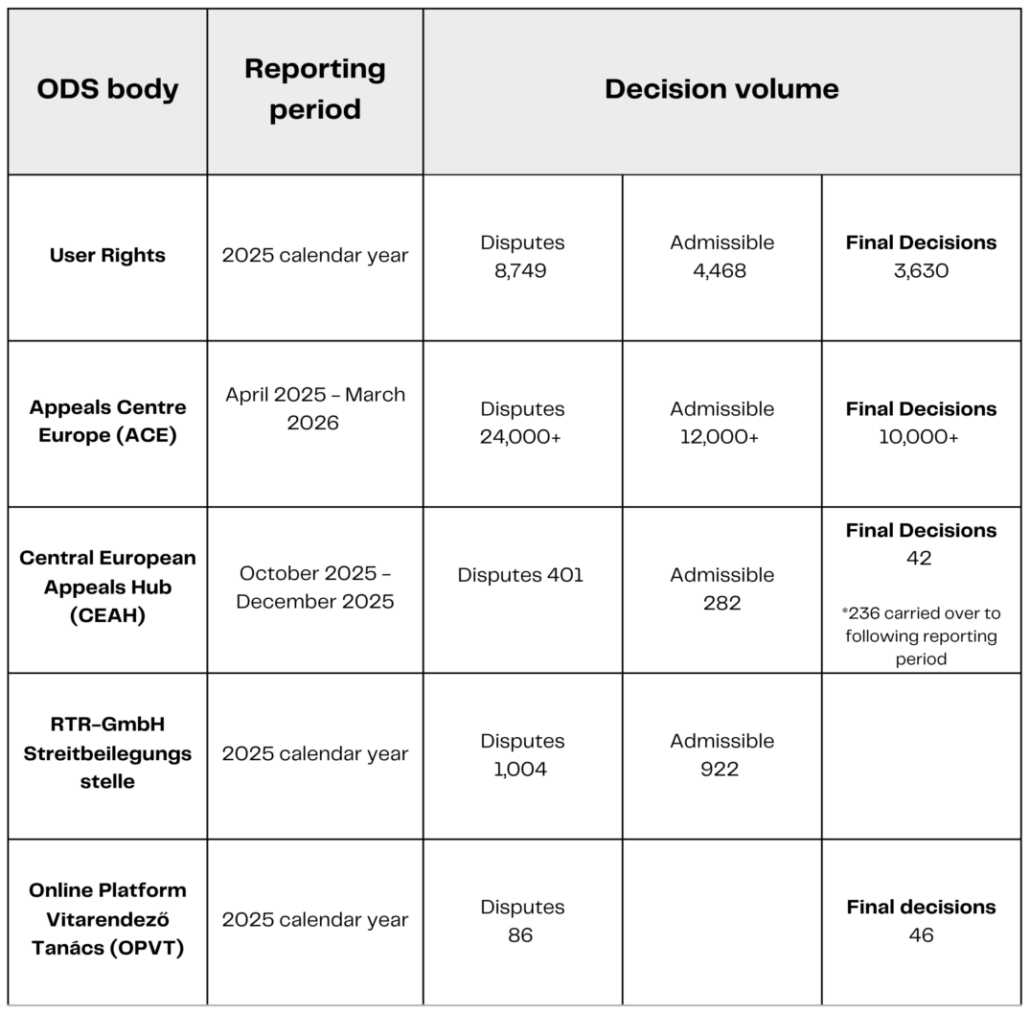
Table 1: ODS bodies, relevant transparency reporting periods, and data summary.
Note: Volumes vary by ODS bodies since they started operations at different times and report on different periods. OPVT, Hungary’s statutory out-of-court settlement body, operates under a distinct model, with proceedings limited to Hungarian language and subject to a nominal filing fee. RTR-GmbH does not report on the number of final decisions.
Note II: Disputes may be deemed inadmissible by the receiving ODS body for a range of reasons, e.g. that the ODS body is not competent in the relevant subject matter, or finds there is no dispute within the meaning of Article 21. See the User Rights Transparency Report (p. 45-46) for more explanation of admissibility criteria.
Three key factors define the ODS system’s added value for users: the outcome of ODS decisions, their effectiveness (i.e. whether platforms implement those decisions), and the broader benefit they can provide beyond their immediate effects.
Outcomes of ODS decisions
Existing data suggests that ODS bodies are more likely to decide in favour of complainants than not. According to the User Rights Transparency Report 2025, in 84.4% of concluded proceedings, the platform’s original decision was deemed unjustified. In over 7,000 of its decisions, ACE was not able to review the content in question and made a “default decision.” In the 3,000 decisions where it was able to review the content, it decided in favor of the user in 59% of the cases. The OPVT report also states that it most commonly recommended restoring the content/account or removing the restriction.
Effectiveness of decisions
User Rights identifies two main ways of measuring effectiveness. The first metric takes an institutional perspective, and measures whether the relevant content is ultimately handled in line with the ODS body’s recommendation — covering immediate remedies, decisions implemented in favour of complainants, and confirmed platform decisions. The overall effectiveness rate for this metric stood at 64.9%, but with marked variation across platforms: at TikTok it approached 90%, whereas for Meta platforms it was around 13%.
A second metric measures effectiveness from the complainant’s perspective. It indicates how often they ultimately get what they want, meaning that a restriction is lifted or that reported content is removed. This includes cases in which platforms grant the desired action through an Immediate Remedy—where the platform corrects its decision at an early stage of the proceedings—or when a substantive decision is rendered in the complainant’s favour and implemented by the platform. User Rights’ report shows that this rate also varied considerably across platforms, ranging from 69% at TikTok and 53% at LinkedIn and below 7% for Meta platforms overall.
Broader benefits to users
Beyond questions of outcome and implementation of ODS proceedings, another dimension of added value concerns user empowerment. Clear reasoning provided for each decision drives the broader user empowerment value of ODS bodies, aligning with Article 21’s goal of helping users access remedies and ensuring that their voices are heard. A well-reasoned decision demonstrates how the ODS body considered the user’s arguments. This, in turn, empowers the user to decide on further remedies — for instance, compelling reasoning in the user’s favour might encourage them to take their case to court. Conversely, clear reasoning in a decision against the user may help deter them from taking costly legal action that is unlikely to succeed. User Rights publishes anonymised case decisions that provide further insight into the reasoning applied in a specific case.
Value and incentives for platforms
While the ODS system is primarily a user-centric remedy, another important question is what added value ODS bodies provide to platforms. While platforms are required to cover the costs for ODS procedures, platforms could also benefit from engaging constructively in this framework and need not regard it only as a compliance cost.
Strategically for platforms, the ODS system provides an independent, external review that can help make large-scale AI-driven content moderation more accountable and sustainable. User Rights reports that, in 84.4% of concluded proceedings, the original platform decision was not upheld by the ODS body, and in 72.1% of cases involving substantive legal review, the platform’s assessment did not withstand independent scrutiny. These figures illustrate why an accessible external correction mechanism can serve as a meaningful and necessary complement to automated moderation at scale.
Operationally, the ODS framework, if done well, can also serve as a source of quality assurance. A well-reasoned decision provides the platform with the specific feedback needed to inform its internal quality assurance. Platforms can use this to inform targeted improvements to their policies, processes and operations. By analysing trends in ODS decisions—especially those that provide a rationale—platforms can unlock insights to refine inconsistently applied policies, adjust automated system thresholds or update moderation agent training.
Realising this potential, however, depends on platforms engaging with ODS bodies and having the necessary internal resources, processes and tooling to make use of such feedback.
In addition to providing the means for platforms to improve their internal processes, the ODS system creates the incentives to do so: by improving internal moderation, platforms may also reduce the number of disputes escalated externally to ODS systems. This would ultimately lead to fewer dissatisfied users, lower platform spending on ODS fees and a more robust moderation framework.
From a compliance and reputational perspective, the benefits can be tangible. Firstly, for VLOPs, Article 35 DSA identifies the implementation of ODS decisions as a potential risk mitigation measure. Secondly, integrating independent external review can strengthen how platforms assess and document the impact of their moderation systems on users’ fundamental rights—such as freedom of expression—within their Article 34 DSA systemic risk assessments.
Finally, under DSA transparency reporting obligations (Article 24), platforms must publicly disclose the number of ODS disputes submitted, the outcomes, the median time needed for completing the ODS procedure, and the share of decisions implemented. Effective collaboration with ODS bodies is therefore essential, as discrepancies between ODS reporting and platform reporting can be an avenue for regulatory scrutiny.
Outlook and key drivers
Harnessing this spectrum of benefits for users and platforms won’t occur on its own.
Clearer admissibility thresholds
The 2025 data highlights some ongoing uncertainty among users regarding the ODS system’s boundaries. According to the User Rights report, of the 8,749 cases received, 4,281 were declared inadmissible. Around half of those inadmissibility decisions related to disputes considered to fall outside the scope of Article 21 DSA, underscoring ongoing uncertainty regarding the mechanism’s boundaries. This was a shared issue across ODS bodies: OPVT, for instance, rejected cases where accounts were suspended following hacking incidents on the basis that no distinct challengeable decision under Article 21 could be identified. The effectiveness of the ODS system therefore hinges on multiple axes that are still being defined as the ODS system develops beyond the legal baseline set out in Article 21 DSA.
Platform participation
Platform participation is fundamental to the system’s effectiveness, and the 2025 data shows it remains an area where progress is most needed. Participation matters not only at the implementation stage, but also earlier in the procedure—particularly when platforms are asked to supply the information needed for review. CEAH notes that in some cases platforms provided only brief, standardised, or abstract submissions, and that the absence of adequate procedural cooperation had a direct impact on the quality of the factual basis available for decision-making. RTR-GmbH reports that in approximately 44% of admissible cases, cooperation was hindered by a complex platform onboarding process. The OPVT report describes a similar experience: while a dedicated case submission interface with the dominant platform in its caseload was established during 2025, it experienced technical problems throughout the year. Further, the User Rights report shows that, amongst cases dealing with content restrictions and where platforms were expected to provide the restricted content to allow for a substantive review, 66% of decisions were rendered on the basis of missing information rather than a full review on the merits. In nearly 100% of those cases, a procedural decision was issued in favour of the complainants.
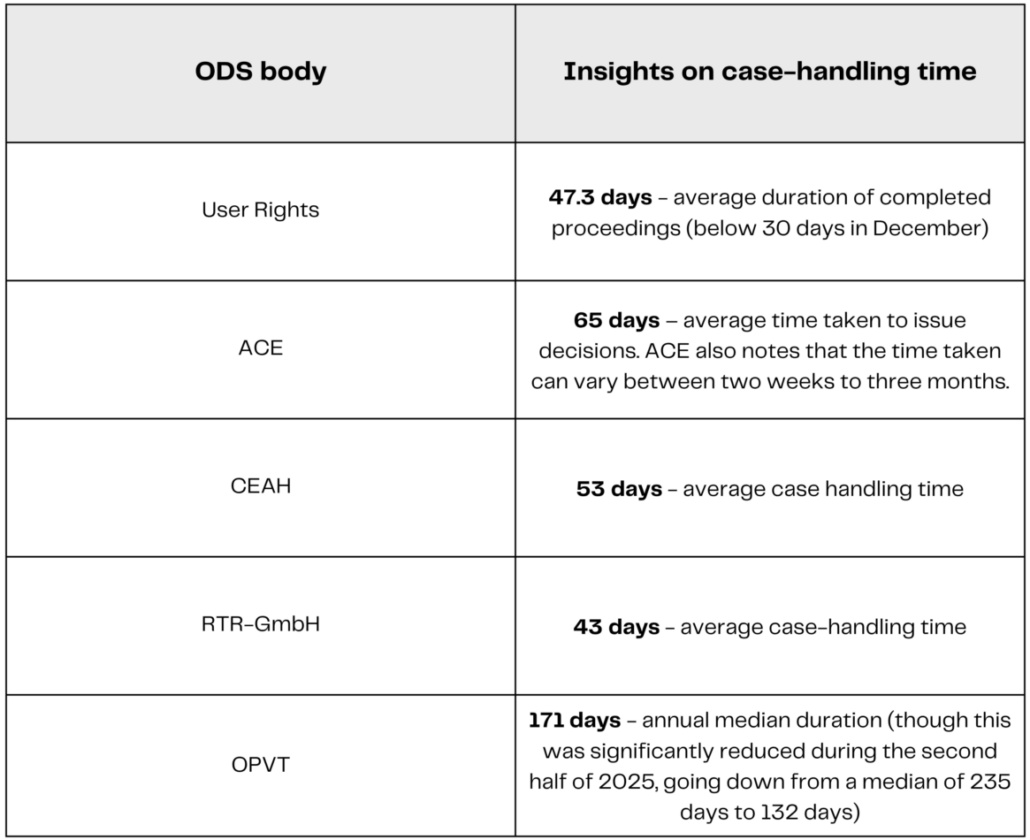
Further, platform responsiveness to ODS requests directly impacts case review times. Often, how promptly platforms engage has a direct bearing on the speed and quality of the ODS decision. ODS transparency reports show some meaningful improvements in case handling time over the last year, often below the 90-day maximum set by Article 21 DSA.
Technical infrastructure
Technical infrastructure, both on the platform side and between platforms and ODS bodies, is essential for an effective and scalable ODS ecosystem. On the platform side, tracking content moderation decisions end-to-end can still prove to be a challenge in some platforms, making it difficult to locate relevant data, compile enforcement histories, and transmit this information to ODS systems. The more complex and siloed a platform’s internal workflows, the greater the challenge in supplying the data required for prompt participation. Additionally, stronger technical interoperability between platforms and ODS bodies—through APIs or other standardised data-sharing solutions—will be key to improving efficiency and consistency across the system. As ODS bodies will increasingly be opening up to receiving user complaints across the online platform ecosystem – and not only VLOPs – standardised solutions to reduce processing burden on all sides will be essential.
Early-resolution mechanisms
Further, process incentives can also support faster resolution. One example is a mechanism that enables early resolution by allowing platforms to reconsider their original moderation decision at the outset of the ODS process. At the beginning of proceedings, the complainant’s explanation is shared with the platform, which is invited to respond and may revert its original decision without the ODS body needing to rule on the substance of the complaint. For example, CEAH recorded immediate remedy in 10% of cases (16 of its 165 concluded proceedings) across a broad range of platforms. User Rights reported that immediate remedies accounted for 35.8% of completed cases, however, specifying that this figure masks considerable variation: at one platform, more than half of cases were resolved through immediate remedy, while at another the rate remained around 2%. Across both bodies, this shows scope for this mechanism to be more widely embraced as a practical and efficient route to resolution.
Transparency on implementation
There is also space for a more standardised approach to transparency around decision implementation. Some ODS bodies, like User Rights, have a standardised process for requesting implementation information from platforms and are able to report comprehensively on it, while others have less standardised approaches (CEAH, for example, reports difficulties in tracking whether and how platforms follow up on decisions). As the sector matures, standardising implementation reporting across ODS bodies would strengthen the evidence base on which all stakeholders can assess the system’s effectiveness.
Emerging ecosystem initiatives
While the reports published to date show that the ODS system has made significant progress in only under two years, many questions remain open. A constellation of initiatives is already working to define emerging practices. These include networks of ODS bodies (such as the ODS Network), academic advisory groups (for example, User Rights’ “Article 21 Advisory Board”), regulator-led forums (such as a working group within the European Board for Digital Services), and working groups within industry associations—for instance, the Digital Trust & Safety Partnership (DTSP), which has launched an ODS Working Group. The goal of these initiatives is to foster further efficiencies and generate added value for both users and platforms.
Conclusion
The first published data shows that while the ODS system offers significant promise — correcting a substantial share of platform decisions — its effectiveness remains uneven and dependent on cooperation. Unlocking its full potential therefore hinges on building robust cooperation between platforms and ODS bodies. On the platform side, this loop starts by informing users about their rights (a requirement under DSA Article 17) and extends to engaging during and after the dispute process—including through implementing ODS decisions. On the ODS side, ODS bodies should focus on providing well-reasoned decisions, setting the standards that will create added value to both users and platforms, as well as efficiency and fairness.
Viewed this way, the ODS system can evolve into an integrated mechanism, co-designed by ODS bodies, users and platforms themselves, providing a valuable correction mechanism for scaled platform operations, driving continuous improvements, and realising meaningful user redress. With continued collaboration, it can set a new standard for due process in the digital age.
*Note that non-English ODS body reports, notably by RTR-GmbH Streitbeilegungsstelle and Online Platform Vitarendező Tanács (OPVT) have been translated to English using Claude for the purposes of this analysis. We welcome any feedback on inaccuracies or misinterpretation that may have occurred due to mistranslations.
User Rights is Europe’s first certified out-of-court dispute settlement body under Article 21 of the Digital Services Act (DSA) that is specialized in social media. Based in Berlin, it gives users an independent route to challenge platforms’ content moderation decisions. Its Advisory Board discusses the most difficult and significant questions relating to the ODS landscape.